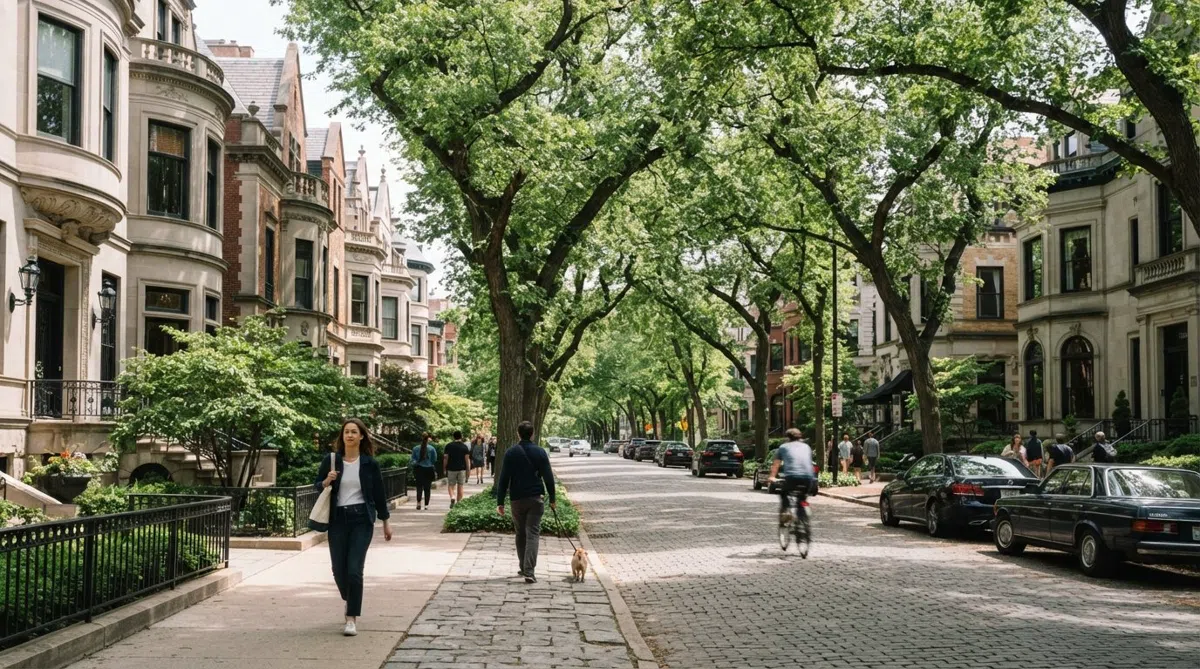
Fifth Avenue was a carriage drive before it was a shopping street, and for roughly forty years either side of 1900 the stretch above 59th Street was the most expensive residential address on earth. Most of those houses are gone, pulled down for apartment blocks within a generation of the men who paid for them, but around a dozen survived by becoming something else — a museum, an embassy's bookshop, a hotel lobby, a chapel, a drill hall. This is the walk through the ones you can still get inside, in a sensible order, with the door policies that catch visitors out.
The four palaces that became museums
The Frick Collection (Upper East Side, East 70th at Fifth) is the anchor of the whole story and the only one of these houses that still works as its owner intended. Henry Clay Frick made his money in coke and steel and built this limestone box in 1914 specifically so that his art, and eventually the public, would outlast him. It reopened in April 2025 after a $220m, five-year restoration that finally opened the second-floor family bedrooms — the single most interesting thing to happen to a New York house museum this decade, because you can now walk the private half of the building and see how small and plain the sleeping rooms were compared with the state rooms below. Admission is $30 adult, $22 senior, $17 student, and ages 10 to 18 go free. It closes Tuesdays, and there is a hard rule worth knowing before you book a family trip: no children under 10 at all, no exceptions. Pay-what-you-wish runs Wednesdays 1.30–5.30pm, which is genuinely good value and correspondingly the busiest four hours of the week. Groups of ten or more book together and enter through the group door at 10 East 71st Street; private and school tours want about two weeks' notice. Note that lecturing aloud in the galleries is not permitted, so a group leader needs headsets or a staff guide.

Cooper Hewitt, Smithsonian Design Museum (Carnegie Hill, Fifth at 91st) occupies Andrew Carnegie's mansion and is the only Gilded Age house on Fifth Avenue you can walk into with its private garden still intact — that garden, on a warm afternoon, tells you more about what this money bought than any ballroom. Go for the free 45-minute Carnegie Mansion tour, which runs daily at 1.30pm and is the reason to come; the design exhibitions are good but secondary to the building. Check the schedule before you travel, though: the second- and third-floor galleries are closed for an exhibition changeover at present, which is why admission is temporarily cut to $10 adult and $5 for seniors and students, with 18 and under free. Any group over eleven must reserve ahead. Self-guided groups cap at 35, and a Design Guide-led private tour caps at 25 and costs $150 on top of admission.

The Jewish Museum (Carnegie Hill, Fifth at 92nd) is C.P.H. Gilbert's 1908 château for the banker Felix M. Warburg, and it is the last Museum Mile palace that still reads unmistakably as a private house from the pavement — the pointed dormers and carved stone were deliberately archaic even in 1908, a new fortune borrowing an old one's clothes. Tickets are $24 adult, $14 senior, $10 student, under 18 free, and the whole museum is free every Saturday. Book a timed slot online or pick one up at the lobby desk. The trap here, and it is the most common wasted trip on the entire avenue, is that this museum closes Tuesdays and Wednesdays, plus Jewish holidays. Guided group and university tours are bookable in advance and the staff are used to adult groups.

Neue Galerie New York (Upper East Side, Fifth at 86th) fills the William Starr Miller House, and it demands a timing warning rather than a recommendation right now: the galleries are shut for renovation and reopen on 12 November 2026. The building is still operating, though — Café Sabarsky, the bookshop and the design shop are already back on normal hours, so you can sit in a panelled ground-floor room over a Viennese coffee without a ticket. When the galleries return, admission is $28 adult with concessions, and the first Friday evening of the month is free from 5 to 8pm. This is a house for couples and pairs, not parties: the staircase and rooms are tight, large coach groups are not workable, the café takes no large-party bookings and the weekend queue for a table is real. No children under 12.

Three mansion interiors for almost nothing
Americas Society (Upper East Side, Park Avenue at 68th) is the one most visitors never hear about, and it is free. The Percy R. Pyne House was saved from demolition in 1965 by the Rockefellers, and walking into its hall off Park Avenue on a weekday morning you will often have the place almost to yourself — an uncrowded Gilded Age interior in a city where that combination barely exists. The gallery is showing Telenovela through March 2027. Hours are the catch: Wednesday to Saturday, 11am to 6pm, and nothing else. It is the best venue on this list for organised groups, with regular private tours for universities and adult groups in English or Spanish, booked through [email protected].

Albertine (Upper East Side, Fifth at 79th) is the cheapest way to stand inside a Stanford White mansion. The Payne Whitney House now holds the French Embassy's cultural services, and its bookshop is free to walk into with no ticket and no reservation — the domed reading room upstairs, painted with constellations, is the kind of space that would carry a $30 admission anywhere else. Keep it in proportion, though: this is a working bookshop in a diplomatic building, so come as two or three people rather than a tour party. It closes Wednesdays, and hours move around embassy events, so check albertine.com the morning you plan to go rather than the week before.
Ukrainian Institute of America (Upper East Side, Fifth at 79th) sits almost opposite, in the Fletcher-Sinclair Mansion, and is the best-value mansion interior in New York at $10 adult, $7 senior, $5 student, under 12 free — a full French Gothic house with its woodwork and stair intact. The honest warning is that it has no standing year-round hours. Public openings come in short posted windows around exhibitions and concerts, so this is never a walk-up; email [email protected] or ring 212-288-8660 and confirm before you build a morning around it. Organised groups are welcomed by arrangement, with plenty of notice.

Two interiors that open only by appointment
House of the Redeemer (Carnegie Hill, East 95th Street) was built in 1914–16 for Edith Shepard Fabbri, Commodore Vanderbilt's great-granddaughter, and it is the one surviving interior of this era you can book privately — a library shipped in from an Italian palazzo, a hall that still smells of wax. Walking tours run by appointment and the house hosts concerts and retreats, with fees kept modest and donations welcome. Book by phone on 212-289-0399 or by email, well ahead. It is strictly appointment-only and will never work as a walk-up, so treat it as the fixed point you plan the rest of the day around.

Park Avenue Armory (Upper East Side, Park Avenue at 67th) is not a mansion, but it is the richest set of period rooms in the story. It holds the only fully intact interiors in the world by Louis C. Tiffany's Associated Artists, with Stanford White consulting — the Veterans Room in particular is the single strangest beautiful room in New York, and the 75-minute guided tour covers it along with the Board of Officers Room and the vast Drill Hall. Tickets are $25 adult, $20 for seniors, students, military and groups, plus fees; the group rate holds at $20 a head. Tours run in seasonal blocks that work around the performance calendar, so check the published dates instead of turning up and hoping.

Sleeping and drinking inside the money
Lotte New York Palace (Midtown East, Madison at 50th) is the one entry where you can actually sleep in the Gilded Age. Henry Villard built these railroad courtyard houses as a single block pretending to be a Roman palace; they became Helmsley's Palace, and Lotte bought and rebranded the hotel in 2015. A free guided tour of the Villard Mansion and Grand Lobby runs every Saturday at 10am and is open to non-guests, which makes it the best free thing in Midtown that morning whether or not you are paying for a room. Rooms are luxury-tier, roughly $500 and up a night. With 30,000 square feet of event space and dedicated meetings and weddings teams, it handles groups better than anywhere else here. If you would rather compare it against the rest of the market, start with a New York hotel search and work out from Midtown.

The St. Regis New York (Midtown, Fifth at 55th) is John Jacob Astor IV's 1904 hotel and the Gilded Age's last gesture — he went down with the Titanic eight years after opening it. It reopened for its 120th year after a Champalimaud restoration, and the Astor family's original Scribner-bound library is now on public display, which is a quietly remarkable thing to be able to stand in front of for nothing. Rooms are very expensive, $1,400 and up. Afternoon tea at La Maisonette runs around $98; the room formerly known as Astor Court is now The Drawing Room. The King Cole Bar is the draw for most people and it is small: cocktails are around $30, smart casual is enforced, no large parties, and your realistic plan is two or three of you arriving early rather than a group turning up at nine.

How a Fifth Avenue family lived before the limestone
Theodore Roosevelt Birthplace National Historic Site (Gramercy, East 20th Street) is free, and it needs one piece of honesty: the house Roosevelt was born in, built in 1848, was demolished, and what stands here is a meticulous 1923 reconstruction furnished with real Roosevelt pieces. That does not make it a waste of an hour — the opposite. It shows how a family of exactly this class actually lived in a narrow brownstone before the limestone palaces, which makes everything uptown legible as the escalation it was. Free guided tours run four times a day at 11am, noon, 2pm and 3pm; the upstairs is tour-only, the lower-floor exhibits are self-guided. It opens Wednesday to Sunday only, group tours should be arranged with the rangers ahead, and it is worth checking the park service alerts for short-notice closures.

The building that settles the argument
New York Public Library, Stephen A. Schwarzman Building (Midtown, Fifth at 42nd) ends the walk on the right note. It was built on Astor, Lenox and Tilden money, it is the most photogenic Gilded Age interior on Fifth Avenue, and it costs nothing, which is the whole point — the private palaces went to the wreckers and this one became everybody's. Free one-hour building tours run at 11am and 2pm Monday to Saturday, limited to the first 20 people who reserve online, so book the moment you know your date. Free 15-minute Rose Reading Room tours go at 11.20am, 1.30pm and 3pm with 25 places each, signed up for in person at the McGraw Rotunda. If you want the room without a crowd, the Rose has a quiet visiting hour from 10 to 11am before readers are admitted, and that is the best photograph of the trip.

What I have left out, and why
No observation decks and no façade-only loop. The point of this subject is interiors, and a walking circuit that only looks up at stonework from the pavement tells you nothing you cannot get from a photograph — the Vanderbilt houses that once ran up this avenue are simply not there any more, and standing outside the office towers that replaced them is a poor use of an afternoon. The shopping blocks between 49th and 59th are not part of this story either, whatever the street's reputation suggests. Everything above earns its place by letting you through the door.
Transport, money and the day that actually works
Museum Mile is a single walk: the 4, 5 and 6 trains run up Lexington Avenue two or three blocks east of Fifth with stops at 68th, 77th, 86th and 96th, and the Q on Second Avenue serves 72nd, 86th and 96th if you are coming from further downtown. The library is at 42nd Street beside Bryant Park and Grand Central; the Roosevelt house is a short walk from 23rd Street; Lotte New York Palace sits between the 51st Street and Fifth Avenue–53rd Street stations. Tap a contactless card or phone straight on the turnstile reader — there is no need to buy a paper ticket, and the fare caps for the rest of a seven-day period once you have paid for twelve rides, which a Museum Mile trip reaches easily.
Cards work everywhere, but carry some small cash for donation boxes at House of the Redeemer and the Ukrainian Institute. On timing, Tuesday is the worst day on this avenue — the Frick and the Jewish Museum are both shut — and Wednesday knocks out the Jewish Museum and Albertine. Saturday is the strongest single day: the Jewish Museum is free, the Villard Mansion tour runs at 10am, Americas Society is open and the library's building tours still run. Thursday or Friday will be quieter if you would rather have the rooms to yourself. On budget, a full paid day comes to about $40 — the Frick at $30 plus Cooper Hewitt at $10 — and a genuinely good free day exists without spending anything: Americas Society, Albertine, the Roosevelt house and the library, with the Carnegie Mansion tour at 1.30pm if you add the $10. For everything else to build a trip around, the New York guide covers the rest of the city.