 In this area
Financial District
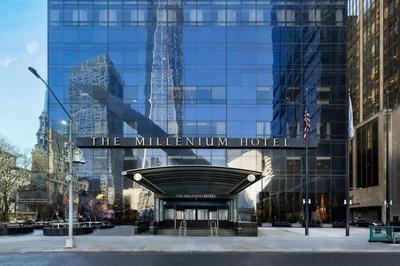
M Social Hotel New York Downtown
7.9· 7,405 reviews
approx. from£597 / nightSee prices
The New York issue
A walk through FiDi’s crooked colonial streets, harbour edges, landmark taverns and high-floor bars, where New York’s oldest grid still runs the show.
By Sol AbramowitzNew York from the deli counter out
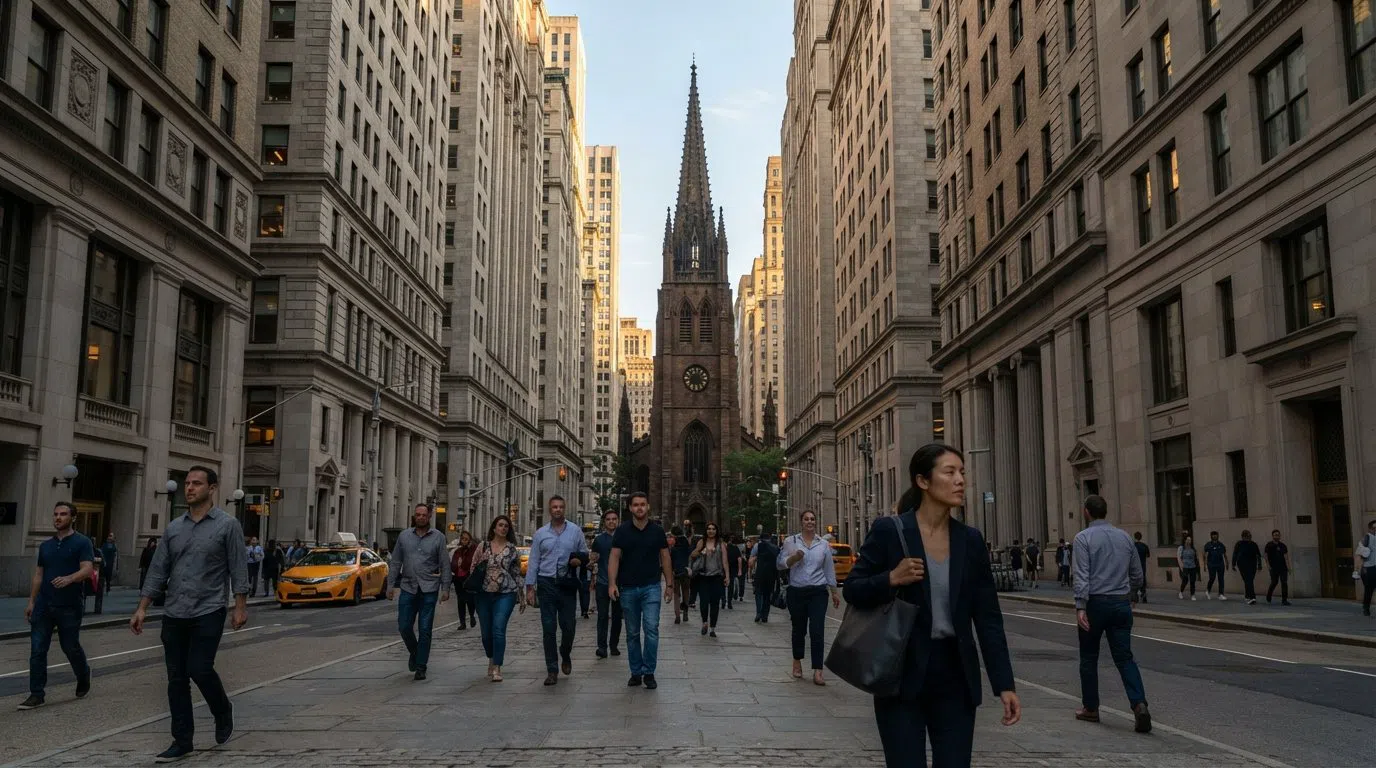
The first thing you notice down here is the speed of the pavement around the New York Stock Exchange at 11 Wall Street and Broad: suits cutting across the corner, coffee in hand, lanyards swinging, the whole block moving like it’s late for a meeting it can’t afford to miss. Then you come back on a Saturday and the same streets go soft. The air changes. The harbour starts talking. FiDi is the oldest corner of New York, built on the seventeenth-century Dutch street grid, and it still wears that old geometry like a crease in a good suit.
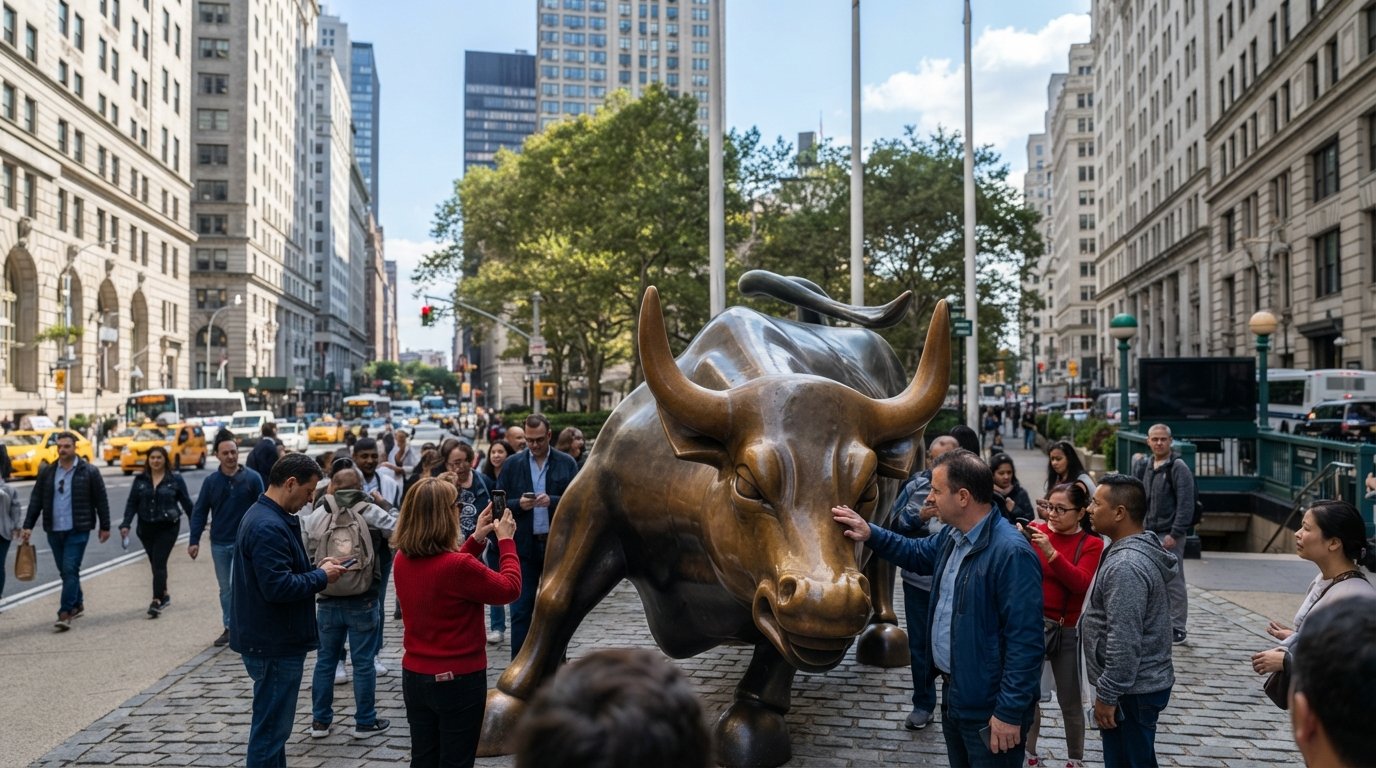
This is Wall Street country, no use pretending otherwise. The New York Stock Exchange is the district’s marquee, and the bronze Charging Bull down by Bowling Green gets the tourists lined up whether they know what it means or not. The bull was quietly installed without permission by Arturo Di Modica in 1989, which feels right for New York: a thing dropped into the street, then absorbed into the city’s permanent furniture. Around it, the district keeps one foot in the money trade and the other in the city’s first century. Trinity Church’s Gothic spire rises where Wall Street begins, Fraunces Tavern reminds you this was Revolutionary New York before it was financial New York, and the crooked lanes still follow the Dutch plan laid out in the 1600s.
That’s the trick with FiDi: it looks like a business district, and in the weekday daylight it absolutely is, but the history is older and stranger than the glass towers would like to admit. The streets are narrow, the corners feel compressed, and the harbour keeps sneaking into the frame at the bottom of nearly every block. One minute you’re under the shadow of 1930s Art Deco towers; the next you’re standing outside a Revolutionary-era tavern with a bank building across the street. Few parts of Manhattan make the layers this visible.
The emotional pull here is that the district never really stops being a working place, even when it empties out. By 7pm the office crowd thins, and by the weekend the whole neighbourhood relaxes into something else entirely: quieter, more atmospheric, and oddly more itself. That’s when the old streets and old names land hardest. Stone Street still reads like a colonial lane because it is one, and Pearl Street still feels like a route to the water because it was built that way.
Live prices from our booking partners.
Free cancellation on many rooms. We may earn a commission when you book.
Stone Street is the neighbourhood’s most obvious pleasure, and not just because it’s cobbled and pedestrian-only and easy on the eye. It’s the place where FiDi remembers how to have a good time. As soon as the weather warms, the restaurants drag long wooden benches into the middle of the street and the whole block turns into one long after-work table. The sound is beer glasses, chair legs, and the particular roar of people who have earned the right to sit outside.
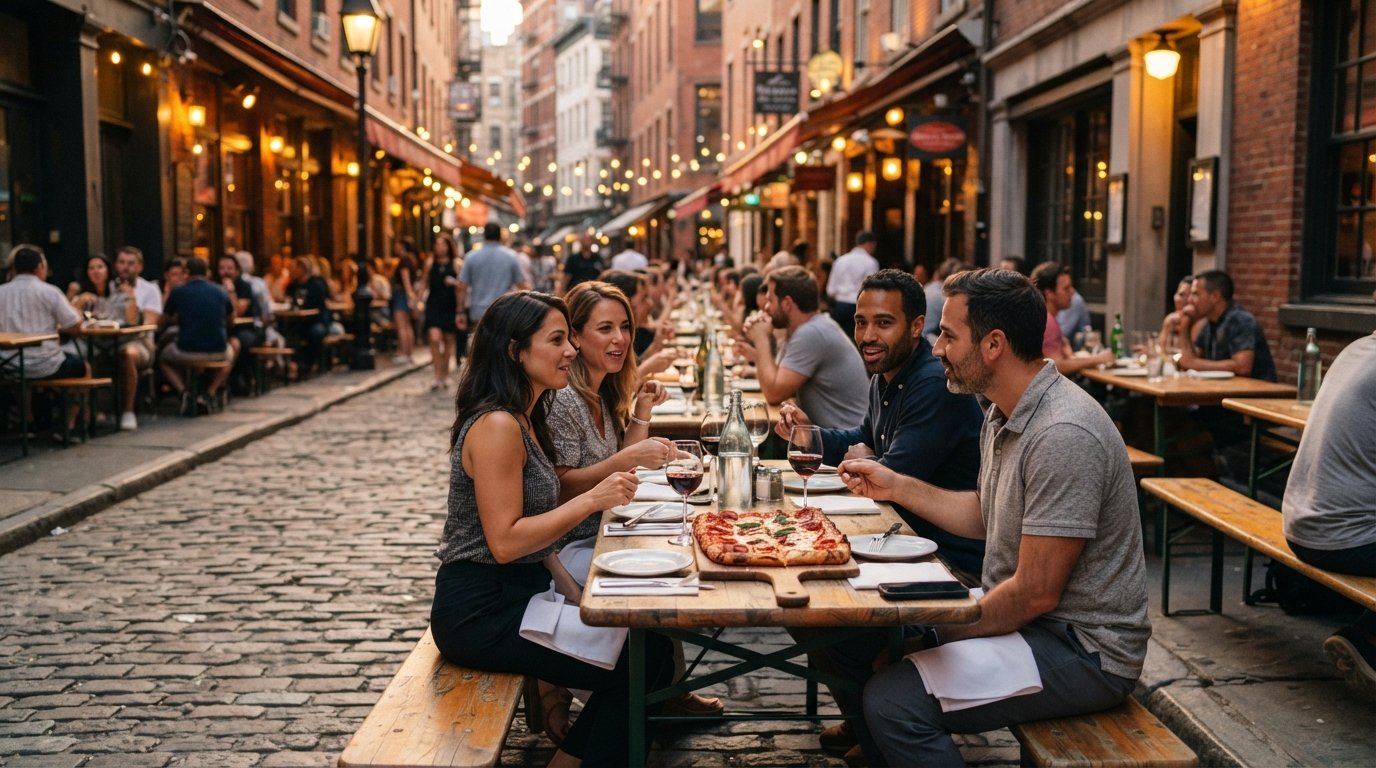
Adrienne’s Pizza Bar, at 54 Stone Street, is the anchor. It’s known for thin, rectangular old-fashioned square pies, sold whole, not by the slice, which is exactly the kind of decision that keeps a place honest. You don’t come here for a dainty lunch. You come because the street is alive and the pizza knows what it is.
The old institutions are the ones worth your time if you like your meals with a bit of history attached. Delmonico’s at 56 Beaver Street is the original fine-dining steakhouse, the place that helped define the whole idea of American luxury dining. The Delmonico steak, eggs Benedict and Baked Alaska are all part of the legend here, and after a long pandemic closure it reopened in 2023, which matters because some rooms survive by reputation alone. Delmonico’s still feels like a room that expects you to sit up straight.
Fraunces Tavern, at 54 Pearl Street, is the opposite in mood but no less serious. It’s an 18th-century tavern and museum with a huge whiskey list and a Revolutionary past thick enough to chew on. You can eat and drink here, yes, but the bigger attraction is the sense that the walls have been listening for a very long time. Across the district, Harry’s at 1 Hanover Square has been a Wall Street steakhouse institution since 1972, tucked into the cellar of India House. It’s the sort of place that knows exactly who it is and doesn’t need to shout about it.
For something more contemporary, Le Gratin at 5 Beekman Street is Daniel Boulud’s French bistro in a neighbourhood that can use a little finesse without losing its edge. The tempura escargots and classic gratins give the room a bit of swagger. Blue Ribbon Sushi Bar & Grill at 84 William Street is a reliable higher-end Japanese room, not flashy, just steady and good. And then there’s the lunch circuit, which is where FiDi quietly proves it can feed itself well: Pisillo at 97 Nassau Street builds enormous Italian sandwiches from top ingredients, Leo’s Bagels at 3 Hanover Square does the neighbourhood egg-and-cheese, Luke’s Lobster at 26 South William Street keeps the Maine lobster roll pared back and clean, and Caravan Uyghur Cuisine at 60 Beaver Street brings hand-pulled lamb noodles and dumplings into the picture. That last one tells you a lot about the district now: this isn’t just bankers and steak. It’s a real lunch neighbourhood, with a wider appetite than the marble suggests.
FiDi’s nightlife is not subtle, but it has its own logic. The district runs on early evenings and high views. You start on the ground, where the after-work crowd gathers, and if the night is good you end it above the streets, looking down at the whole island like you’ve earned a private map.
The Dead Rabbit at 30 Water Street is the headline act. It’s a multi-floor Irish bar and cocktail lounge that was once ranked the world’s best bar, and the reason it works is that it never tries to be one thing only. The ground-floor taproom is rowdy and immediate; upstairs, the cocktail parlour takes itself seriously in the way a good bar should. The whiskey list is deep, the room has energy, and the place understands that a neighbourhood bar can be both welcoming and exacting.
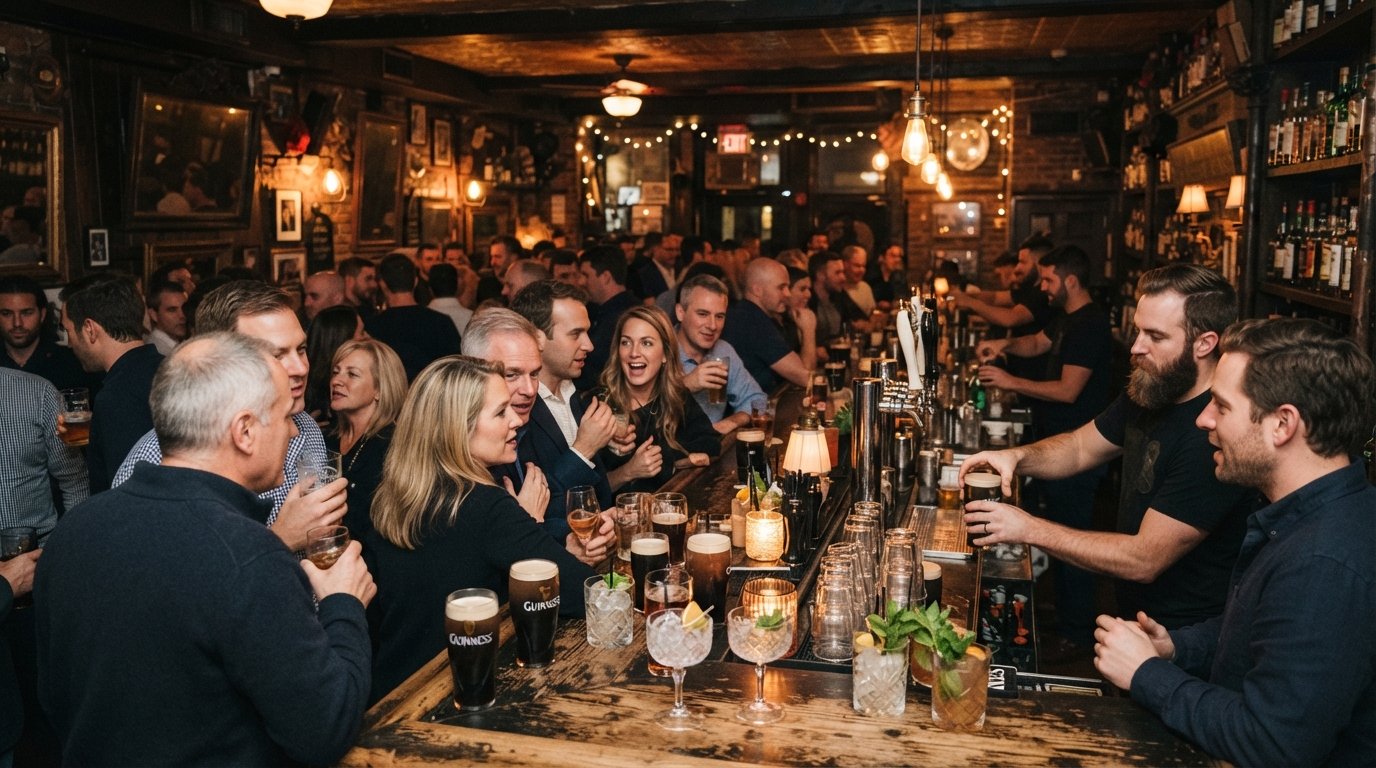
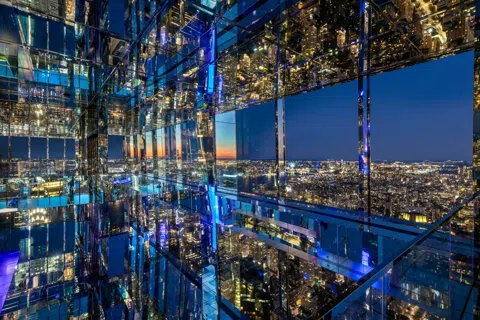
If you want the view rather than the noise, go vertical. Overstory, on the 64th floor of 70 Pine Street, is the sort of room that makes you remember how much of Manhattan is water and how much is angle. It’s a rooftop cocktail bar with a wrap-around skyline panorama, and the Art Deco tower beneath it gives the whole thing a little old-money gravity. Manhatta, on the 60th floor of 28 Liberty Street, is a bar and New American restaurant with sweeping harbour and bridge views. It’s the place for looking out, not down, and the harbour does a lot of the talking.
Back at street level, Ulysses Folk House at 95 Pearl Street keeps the Irish-pub end of the neighbourhood honest. It’s big, lively, and popular for oysters, pints and after-work crowds. On a Thursday it feels like the natural extension of the office day. On a Saturday it can feel like a different city entirely, which is part of FiDi’s charm and part of its warning label. This is not a district built for late-night drift. It’s built for a strong first drink, a good second one, and a view if you want to stretch the evening out.
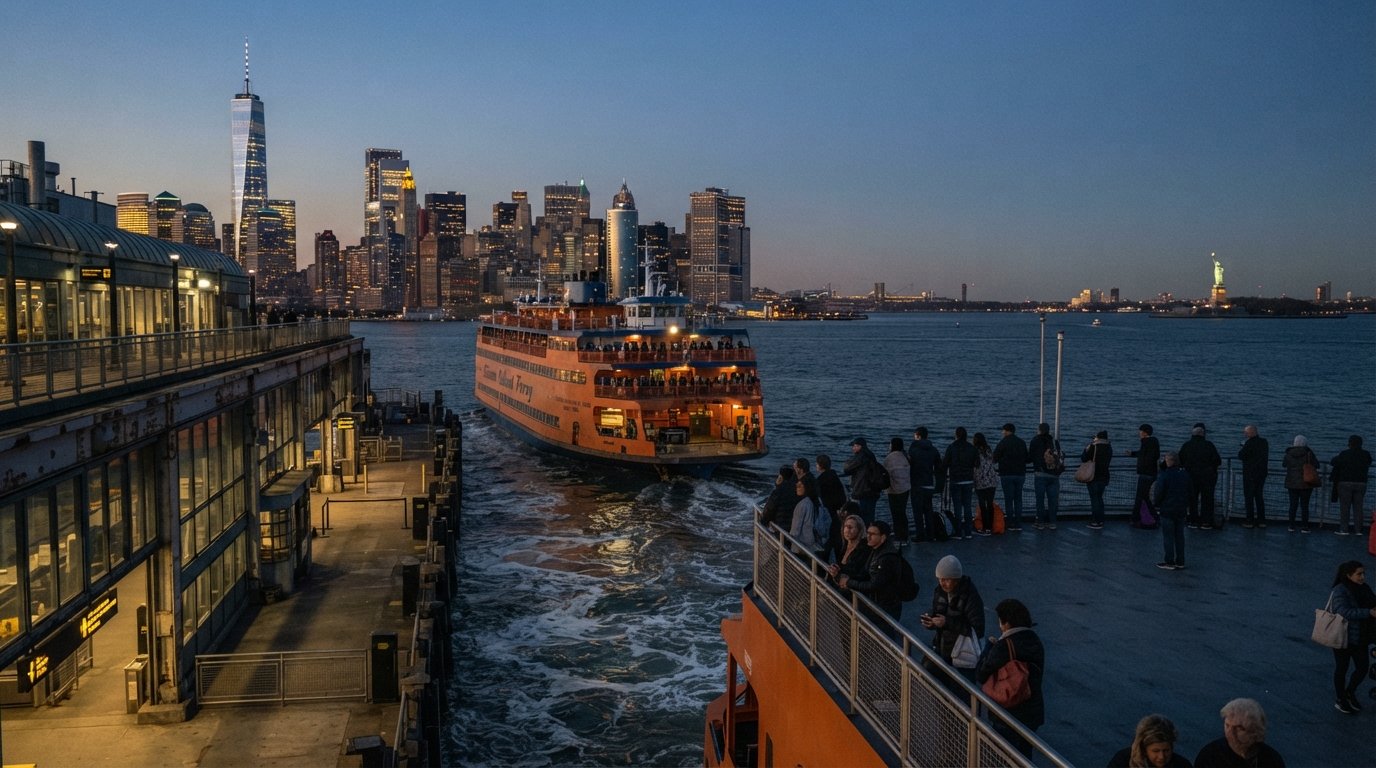
Start with the harbour, because that’s where the city opens itself up without charging you for the privilege. The Staten Island Ferry leaves around the clock from Whitehall Terminal at 4 South Street, and the 25-minute crossing passes within about 500 yards of the Statue of Liberty. Stand on the right-hand side heading out, the starboard side if you want to sound like you know what you’re doing, and let the skyline sit behind you. It costs nothing and needs no ticket, which in New York is almost a civic miracle.
If you want to land on Liberty and Ellis islands, the boats leave from The Battery at the southern tip. That’s also where the harbour makes the most sense geographically: the city ending in water, ferries pushing off, gulls overhead, the whole lower island feeling like a hinge between old New York and the Atlantic.
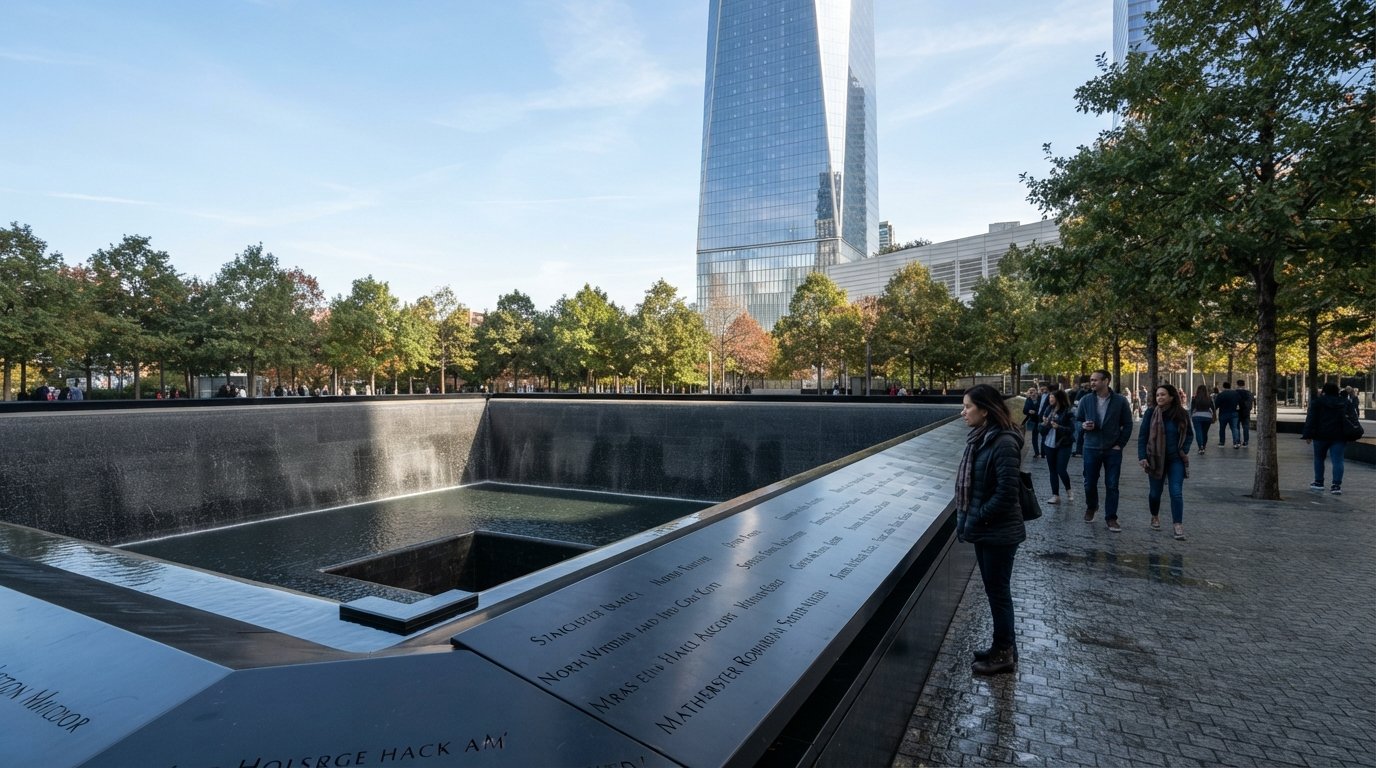
The 9/11 Memorial & Museum is the district’s emotional centre. The memorial plaza is free and open daily, with the two vast reflecting pools sitting in the footprints of the fallen towers and the names of the dead ringing the edges. The museum below is ticketed and serious in the best sense of the word; this is not a place for glibness. Right beside it, One World Observatory on the upper floors of One World Trade Center gives 360-degree views said to reach 45 miles on a clear day. The view is the city at full scale: harbour, bridges, towers, the whole lower half of Manhattan laid out like a model with weather.
From there, the history walk keeps paying out. Trinity Church at Broadway and Wall is free to visit, and its Gothic Revival building dates to 1846. It’s one of those New York sights that keeps its dignity because it doesn’t need to compete with the towers around it. The Charging Bull and the nearby Fearless Girl by the Stock Exchange remain the district’s most photographed pair of symbols, for better and worse. And Fraunces Tavern Museum at 54 Pearl Street gives you the Long Room where Washington said farewell to his officers in 1783, plus a lock of his hair if you want a relic to go with your lunch.
The Oculus
Stone Street historic dining corridor
Federal Hall
Shopping in FiDi is not why people come here, and that’s fine. The district has bigger things on its mind than retail theatre. Still, the newest headline is hard to miss: Printemps New York, the 160-year-old French luxury department store, opened its first-ever US outpost in March 2025 inside the Art Deco One Wall Street tower. It’s designed to feel like a grand Parisian apartment, with two floors mixing fashion and beauty, Café Jalu, and the restored, landmarked Red Room. That’s a proper arrival, and it gives the neighbourhood a fresh reason to wander in from the street.
The workhorse is Westfield World Trade Center, the vast retail concourse spread under and around Santiago Calatrava’s white Oculus transit hall. More than 100 shops and food outlets live there — Apple, Sephora, Eataly and the rest — but the real draw is the Oculus itself, which is free to walk through and worth seeing as architecture alone. It’s a rib-cage of white steel flooded with light, a transport hall that feels almost ceremonial. Still, if you’re looking for the soul of the district, it’s not in the mall. It’s in the streets, the harbour, and the old museum shops at Fraunces Tavern and the 9/11 Memorial, where the souvenirs at least have a sense of place.
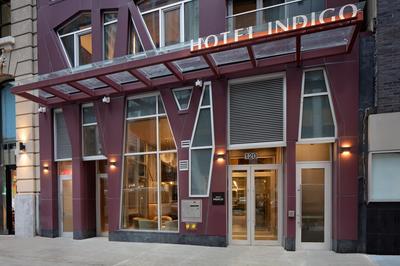
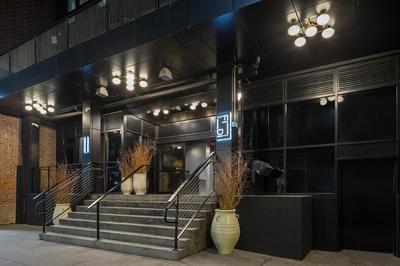
FiDi has become one of Lower Manhattan’s more characterful places to sleep, largely because the old financial architecture keeps getting repurposed into hotels with real personality. The Beekman, a Thompson Hotel, is the showpiece: a jaw-dropping nine-storey Victorian atrium under a pyramid skylight, the sort of lobby that makes you slow down without meaning to. The Wall Street Hotel is a polished boutique property carved from a 1920s building, and Casa Cipriani, in the old Battery Maritime Building on the waterfront, folds a hotel around an exclusive members’ club. Gild Hall, also a Thompson hotel, sits right among the Wall Street towers, while Hyatt Centric Wall Street puts you a short walk from the Seaport, the Stock Exchange and the Liberty ferries.
The trade-off is simple and worth understanding before you book. FiDi is calm, and at weekends it can be almost eerily so. If you want life on your doorstep at 11pm, this is not your patch. If you want quiet harbour-view rooms, landmark bones, and the ability to get across the city quickly, it’s a very good one. And the transport is the clincher: you’re steps from a knot of subway lines that reach the rest of Manhattan fast.
Our best-rated stays in this neighbourhood. Prices are approximate “from” rates — confirmed at the provider when you continue. We may earn a commission if you book through our partners — at no extra cost to you.
In this area In this area
 In this area
 In this area
 In this area
 In this area
 In this area
 In this area
 In this area
 In this area
 In this area
 In this area
The Financial District is small enough to walk without thinking too hard about it — you can cross it in about fifteen minutes — and that’s part of the pleasure. It’s also one of the best-connected corners of New York, because nearly every subway line seems to funnel down to the bottom of the island. Fulton Street station is the big interchange, with the 2, 3, 4, 5, A, C, J and Z lines. The Wall Street stops, Bowling Green, Rector Street, Broad Street and the World Trade Center / Oculus hub fill in the rest, with the E train and PATH trains to New Jersey at the latter.
Midtown is only about 10 to 20 minutes away on the express 4 or 5, which is one reason people who work downtown can live and sleep here without feeling stranded. JFK is roughly 50 to 60 minutes by subway or 35 to 50 by taxi depending on traffic. LaGuardia is around 35 to 45 minutes by cab. Newark is reachable via PATH from the World Trade Center to Newark, then the AirTrain, or by a 30 to 45 minute drive. And don’t ignore the water: the NYC Ferry and the free Staten Island Ferry both leave from here, and on a clear day the harbour crossing beats the subway for the view alone.
The honest read on FiDi is this: it’s one of the quietest and most heavily policed parts of Manhattan, especially around Wall Street, so safety is rarely the issue. The issue is atmosphere. After office hours and on weekends, the streets can feel deserted rather than dangerous. If you like your New York with a little breathing room, some honest history, and a harbour at the end of the block, that’s not a bug. That’s the point.
Gallery
Yes — especially if you want strong transport links, easy access to the harbour, the 9/11 Memorial and the Liberty ferries, and a quieter base than Midtown. The catch is that FiDi goes very quiet at night and on weekends, so it suits travellers who prefer calm over constant street life.
Wall Street, the New York Stock Exchange, the Charging Bull, the 9/11 Memorial & Museum, One World Observatory, the free Staten Island Ferry, and the older colonial landmarks like Trinity Church and Fraunces Tavern.
Yes. It’s one of the safest and most heavily policed parts of Manhattan, especially around Wall Street. It can feel empty after office hours and on weekends, but that’s more a matter of atmosphere than danger.
Weekdays are lively around the financial core, but for most visitors the best time is late afternoon into evening, or weekends, when the streets calm down and the harbour, old lanes and historic buildings are easier to appreciate.